


皰疹病毒感染後一小時內即可重塑人類DNA
DNA & CELL
桑賈娜·加傑比耶
4/15/20262 分钟阅读
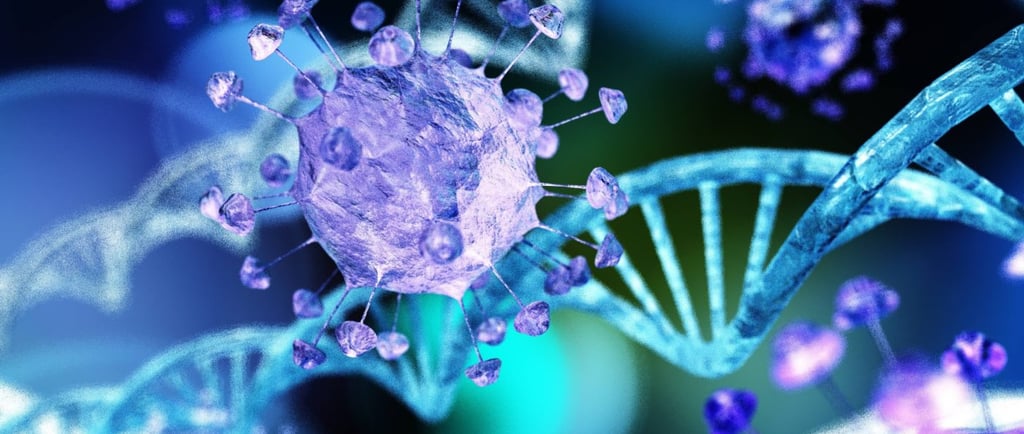
病毒本身沒有生命。它們只能透過侵入活細胞並竊取所需資源來生存。 1型單純皰疹病毒(HSV-1)也不例外。
這種病毒最廣為人知的症狀是引起唇皰疹,在大多數人體內處於靜默狀態。然而,在我們的細胞內,皰疹病毒會對DNA進行一些不尋常的操作。
發表在《自然通訊》雜誌上的一項新研究表明,HSV-1的作用遠不止於劫持宿主的機制。它也會重塑人類基因組的三維結構。這使得病毒能夠接觸到特定的人類基因,從而進行自身的複製。
「HSV-1就像一位機會主義的室內設計師,它能夠極其精準地重塑人類基因組,並選擇與之接觸的片段,」埃絲特·岡薩雷斯·阿爾梅拉博士解釋道。
這種重塑並非副作用,而是病毒有意為之。病毒會在感染後的數小時內重新連接DNA。這些改變使HSV-1能夠建構完美的繁殖空間。
了解皰疹病毒 HSV-1 – 基礎知識
1 型單純皰疹病毒 (HSV-1) 感染了全球絕大多數人口,據估計,50 歲以下人群中超過三分之二的人攜帶該病毒。
大多數人在兒童時期透過非性接觸感染 HSV-1,例如共用餐具或密切的個人互動。
在許多情況下,病毒潛伏在神經細胞中,並因壓力、疾病或免疫抑製而偶爾復發。
雖然身體症狀通常較輕,但圍繞皰疹的社會污名會導致焦慮、尷尬和情緒困擾,尤其是在皰疹發作時。
除了常見的口腔病變外,HSV-1 在少數情況下也會導致更嚴重的後果。該病毒偶爾會透過口交引起生殖器皰疹,進而引發性健康問題。
更嚴重的是,HSV-1 可能導致腦炎——一種可能致命的腦部發炎——尤其是在嬰幼兒或免疫系統較弱的人群中。
皰疹病毒如何控制 DNA
HSV-1 進入細胞後一小時內,就會劫持宿主的 RNA 聚合酶 II (RNAP II)。這種酵素通常利用人類 DNA 合成 RNA。病毒會將其重定向,使其複製自身的基因。
拓樸異構酶 I (TOP1) 負責剪接 DNA 以減輕壓力,它也加入了病毒的劫持行動。黏連蛋白負責幫助 DNA 折疊,也會往病毒基因組移動。這些酵素共同幫助 HSV-1 建構病毒複製區室 (VRC)。
在這些區室中,人類的轉錄速度顯著減慢。 RNAP II 和 TOP1 會放棄宿主 DNA。結果,染色質——DNA 的緊密包裝形式——會坍縮成一個僅正常體積 30% 的外殼。
VRC 迅速生長。宿主DNA被推至細胞核邊緣。人類基因活性驟降。病毒RNA在數小時內充斥細胞。
Surprising turns in genome folding
Cohesin partially joins the virus party and forms short loops near viral DNA. But much of its usual function is lost. Some host DNA loops vanish, while others stay intact. The virus rewires specific loops to boost genes it benefits from.
Despite this damage, parts of the human genome resist. A/B compartments – large regions of active or inactive DNA – stay largely intact. This shows that chromatin can keep its broad structure, even under viral attack.
Another twist: HSV-1 does not rely on altering chemical markers like H3K27me3 or H3K9me3. It leaves these epigenetic marks unchanged. Instead, it changes the physical shape and positioning of DNA.
“We always thought dense chromatin shut genes down but here we see the opposite: stop enough transcription first and the DNA compacts afterwards. The relationship between activity and structure might be a two-way street,” noted Dr. Álvaro Castells García from Southern Medical University in Guangzhou, China.
One enzyme blocks the virus
The researchers found a key weakness in the viral plan. Blocking just one host enzyme, TOP1, completely halted HSV-1’s genome reshaping. Without this enzyme, VRCs failed to form. The virus could not make a single new particle.
“In cell culture, inhibiting this enzyme stopped the infection before the virus could make a single new particle,” noted Professor Pia Cosma.
TOP1 is now a potential target for new therapies. Since nearly two-thirds of people under 50 carry HSV-1, a treatment like this could have a huge impact.
The herpes virus rewires DNA
The researchers used advanced tools to uncover HSV-1’s tactics. Super-resolution microscopy let them see features just 20 nanometers wide. Hi-C showed which parts of DNA were in contact.
The virus genome tends to associate with active, gene-rich regions in human DNA. These contacts likely help the virus turn on the genes it needs.
Throughout infection, HSV-1 genome clusters remain stable in size. RNAP II binds closely to them. Cohesin binds loosely. This balance supports ongoing replication.
The findings show that HSV-1 does not just invade. It rewires and reorganizes human cells with precision. Right now, there is no cure for HSV-1. People can treat symptoms, but the virus stays in the body for life. This study shows a new way to fight it.
If we stop the virus from reshaping human DNA early in the infection, we might stop it from spreading which could lead to new treatments.
The study is published in the journal Nature Communications.